
Improve your body through science-based fitness and physiology
How Intermittent Fasting Works for Beginners: A Complete Guide
Learn how intermittent fasting works and what happens in your body during fasting. A beginner-friendly guide to fat burning, fasting stages, and methods explained simply.

Intermittent fasting has become one of the most popular ways to manage weight and improve eating habits, but most people still don’t fully understand how intermittent fasting works inside the body.
If you’re new to fasting, you may want to first understand the benefits of intermittent fasting for beginners before diving into how it works
At its core, intermittent fasting isn’t about what you eat — it’s about when you eat. By cycling between eating periods and fasting periods, your body gradually shifts how it uses energy, moving from quick-access fuel (glucose) to stored energy (fat).
What makes this interesting is that your body doesn’t switch instantly. It moves through different stages over time, almost like a fat-burning slider gradually shifting upward the longer you go without food.
What Is Intermittent Fasting?
Intermittent fasting is an eating pattern where you alternate between periods of eating and fasting.
Instead of focusing on calorie counting, you follow a time-based structure such as:
- 16:8 (16 hours fasting, 8 hours eating)
- 14:10
- 12:12 (beginner-friendly)
- 5:2 approach
- Alternate fasting methods like Eat-Stop-Eat
Each method changes how long your body stays in a fasted state, which affects energy use, hunger, and fat metabolism.
The Three Body States in Intermittent Fasting
To really understand how intermittent fasting works, you need to understand the three main metabolic states your body cycles through.
1. Fed State (0–4 hours after eating)
This is the period right after a meal.
Your body is:
- Digesting food
- Using glucose (sugar) for energy
- Releasing insulin to move nutrients into cells
During this phase, fat burning is very low because your body is using incoming energy. Insulin plays a key role in how your body stores and uses energy, especially when it comes to fat storage and weight management
2. Early Fasting State (4–12 hours)
This is where things start to shift.
Your body is:
- Finishing digestion
- Lowering insulin levels
- Beginning to use stored glycogen (carbs stored in the liver)
Energy is still mostly coming from stored carbs, but the switch has started.
3. Fasting State (12–24+ hours)
This is where the deeper changes happen.
Your body is:
- Glycogen stores becoming depleted
- Increasing fat breakdown for energy
- Becoming more efficient at using stored fuel
This is where people often notice more stable energy and reduced hunger. This is also the stage where many people wonder whether they should train fasted and how it affects performance
Think of Fat Burning Like a Slider
A simple way to understand what happens during intermittent fasting is to imagine a fat-burning slider:
- When you just ate → slider is low (mostly glucose use)
- After several hours → slider starts moving upward
- 12–16 hours → halfway up (mix of glycogen + fat)
- 16–24 hours → higher fat usage
- 24+ hours → strong reliance on stored fat
The longer you stay fasted (within reason), the more the slider shifts toward fat as a fuel source.
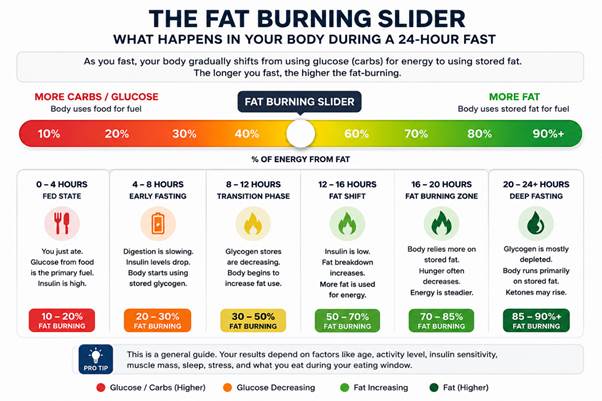
Fat Burning “Slider” During a 24-Hour Fast
| Time Fasted | Body State | Carb (Glucose) Use | Fat Use | What’s Happening |
| 0–4 hrs | Fed state | Very High | Very Low | Food is being digested, glucose is main fuel |
| 4–8 hrs | Early fasting | High | Low | Blood sugar stabilising, glycogen is used |
| 8–12 hrs | Transition | Moderate | Low–Moderate | Glycogen starts dropping |
| 12–16 hrs | Early fat shift | Moderate–Low | Moderate | Fat burning begins increasing |
| 16–20 hrs | Fat-burning zone | Low | High | Body relies more on stored fat |
| 20–24 hrs | Deep fasting | Very Low | Very High | Strong fat reliance, glycogen mostly depleted |
What Happens Hour by Hour (Up to 24 Hours)
Here’s a clearer breakdown of how intermittent fasting explained looks in real time:
0–4 Hours
- Food is being digested
- Insulin is elevated
- Energy comes from glucose
4–8 Hours
- Digestion slows down
- Blood sugar stabilizes
- Body starts using stored glycogen
8–12 Hours
- Glycogen becomes the main fuel source
- Hunger may come in waves
- Insulin continues to drop
12–16 Hours
- Glycogen is running lower
- Fat breakdown begins increasing
- Body shifts toward fat as fuel
16–20 Hours
- Fat becomes a more dominant energy source
- Hunger often reduces for many people
- Energy may feel more stable
20–24 Hours
- Stronger reliance on stored fat
- Deeper metabolic shift occurs
- Body prioritizes efficiency and energy conservation
Popular Intermittent Fasting Methods Explained
Different fasting methods simply stretch or shorten these states.
16:8 Method
This is the most common approach.
You fast for 16 hours and eat within an 8-hour window.
It naturally pushes your body into the early fasting and fasting state daily.
This method is popular because it’s sustainable and fits into normal routines like skipping breakfast or early dinners. However, one of the biggest challenges for beginners is managing hunger during the fasting window
Eat-Stop-Eat Method
This method involves fasting for a full 24 hours once or twice per week.
For example:
- Eat dinner at 7pm
- Fast until 7pm the next day
During this fast, your body spends more time in the deeper fasting state, where fat usage is more noticeable.
It can be effective, but it’s also more demanding and not ideal for beginners who are still adapting.
Alternate-Day Fasting (ADF)
This method alternates between eating days and low-calorie or fasting days.
One day you eat normally, the next you either:
- Fast completely, or
- Eat very minimal calories
ADF creates a strong swing between fed and fasted states, which can increase fat loss potential for some people, but it can also be harder to maintain socially and mentally.
What Actually Drives Fat Loss?
A common misunderstanding is that fasting automatically “burns fat.”
In reality, fasting creates conditions where:
- Insulin drops
- Energy intake is reduced
- Stored fuel becomes more accessible
But fat loss still depends on overall consistency and calorie balance across time.
Does Intermittent Fasting Burn Fat?
A common question among beginners is whether fasting automatically leads to fat loss.
Intermittent fasting can support fat loss because fasting periods may help reduce overall calorie intake and shift the body toward using stored energy. However, results still depend on factors such as:
- Total food intake
- Food quality
- Activity levels
- Sleep
- Consistency
Fasting itself is not a shortcut, but it can become a useful structure for some people. While fasting can support fat loss, the quality of food during eating windows also plays a major role in results and overall energy levels
Is Intermittent Fasting Good for Beginners?
For many people, intermittent fasting can be a simple way to create more structure around eating habits.
If you are starting out:
- Begin with a shorter fasting window
- Stay hydrated
- Avoid overeating during eating periods
- Prioritize balanced meals
- Adjust gradually
A sustainable approach is often easier to maintain than an aggressive schedule.
Common Mistakes People Make When Starting
When learning how intermittent fasting works for beginners, these are common issues to avoid:
- Starting with fasting windows that are too long
- Eating too little overall
- Ignoring protein intake
- Treating fasting as permission to binge
- Expecting immediate results
Consistency usually matters more than intensity.
Who Should Be Careful With Fasting?
Intermittent fasting may not be appropriate for everyone.
You should speak with a healthcare professional before trying it if you:
- Are pregnant or breastfeeding
- Have diabetes or blood sugar concerns
- Take medications that affect eating schedules
- Have a history of disordered eating
- Are underweight
Final Thoughts: How Intermittent Fasting Works in Real Life
Understanding how intermittent fasting works makes the whole process feel less confusing and much more practical. Instead of being a strict diet, it’s really just a structured eating pattern that helps your body shift between using food energy and stored energy over time.
As you fast, your body gradually moves through different stages — from using glucose right after eating, to tapping into stored glycogen, and eventually increasing its reliance on stored fat. This is what creates the “fat-burning slider” effect many people refer to.
For beginners, the most important thing to remember is that you don’t need to be perfect. Starting with a simple method like 12:12 or 16:8 is often enough for your body to adapt without stress. From there, you can adjust based on how you feel, your energy levels, and your lifestyle.
Intermittent fasting is not a quick fix, but when done consistently, it can become a simple and sustainable way to manage eating habits and better understand your body’s natural rhythms.
Frequently Asked Questions
1) What happens to your body when you start intermittent fasting?
When you first start fasting, your body continues using energy from your last meal. After a few hours, it begins lowering insulin levels and switching to stored glycogen for energy.
For example, if you eat dinner at 7 PM and skip breakfast, your body will still be using glucose overnight before gradually shifting toward stored energy in the morning.
2) When does fat burning actually start during fasting?
Fat burning usually starts increasing after about 12 hours, when glycogen stores begin to drop. It becomes more noticeable between 14–16 hours of fasting.
For example, during a 16:8 fasting schedule, your body may start relying more on fat toward the end of the fasting window before your first meal.
3) Is intermittent fasting safe for beginners?
Yes, for most healthy people it is safe when done gradually. Beginners often start with a 12:12 schedule and slowly increase fasting time.
For example, someone might start by finishing dinner at 7 PM and eating breakfast at 7 AM, then later shift breakfast to 9 AM or 11 AM as they adjust.
4) What can I drink while fasting?
You can usually drink water, black coffee, and unsweetened tea during fasting periods. These do not significantly affect insulin levels.
For example, many people drink black coffee in the morning to help reduce hunger without breaking their fast.
5) How long does it take to see results from intermittent fasting?
Results vary, but many people notice changes in energy or appetite within 1–2 weeks. Visible weight changes may take longer depending on diet and consistency.
For example, someone who combines a 16:8 schedule with balanced meals may notice reduced snacking within the first week.
