
Improve your body through science-based fitness and physiology
Natural Movement Habits: Simple Ways to Beat a Sedentary Lifestyle
Discover natural movement habits modern life has made us forget, from squatting and walking to carrying, balancing and spending more time outdoors.

Think about how much of your day you spend sitting, walking short distances, looking at a screen, or repeating the same movements. Modern life is convenient, but it has also quietly removed many of the natural movement habits that used to be part of ordinary daily life. We no longer need to walk everywhere, carry everything ourselves, squat down to work at ground level, or climb and balance as part of our daily routines. That convenience is useful, but it raises an interesting question: are there simple ways of moving that we have gradually stopped doing?
This is not about pretending that life was better in the past. Previous generations often worked physically demanding jobs, and many people had little choice about how much labour they performed. We don’t need to copy their hardships. But we can learn something from the variety of movements that everyday life once required—and find practical ways to bring some of that variety back.
You don’t need an expensive gym membership or a complicated training programme to start. In many cases, it begins with changing how you move between the things you already do.
What Are Natural Movement Habits?
Natural movement habits are the ordinary ways we use our bodies throughout the day: walking, squatting, reaching, carrying, climbing, balancing, and getting up and down from the ground.
These movements are not a replacement for structured exercise. Strength training, cardiovascular exercise and sport all have important benefits. But everyday movement is another part of the picture.
The World Health Organization’s guidance on physical activity recognises that physical activity includes more than formal workouts. Walking for transport, household tasks, recreation and active play all count.
The problem is that modern routines often remove movement from daily life. We drive instead of walk, use lifts instead of stairs, sit at desks for hours and order things to be delivered to our doors. None of these conveniences is automatically bad. The issue is what happens when almost every task becomes an opportunity to remain still.
Here are six everyday movement habits worth bringing back into your routine.
1) Squatting and Getting Comfortable Closer to the Ground
Think about the last time you sat on the floor to do something. Perhaps you played with a child, worked in the garden or reached for something on a low shelf. For many adults, getting down and back up again is no longer an everyday occurrence.
Chairs are comfortable and useful, but they can also mean we rarely practise moving into and out of a squat or changing position close to the ground.
A study of the Hadza, a contemporary hunter-gatherer population in Tanzania, found that people spent considerable time resting, much like people in industrialised societies. However, their resting postures often included squatting and kneeling, which involved more lower-limb muscle activity than sitting in a chair. This doesn’t prove that squatting is always better, but it illustrates how the way we rest can change the amount of movement our bodies get.
You don’t need to sit on the floor all day. The aim is simply to retain the ability to move comfortably through different positions.
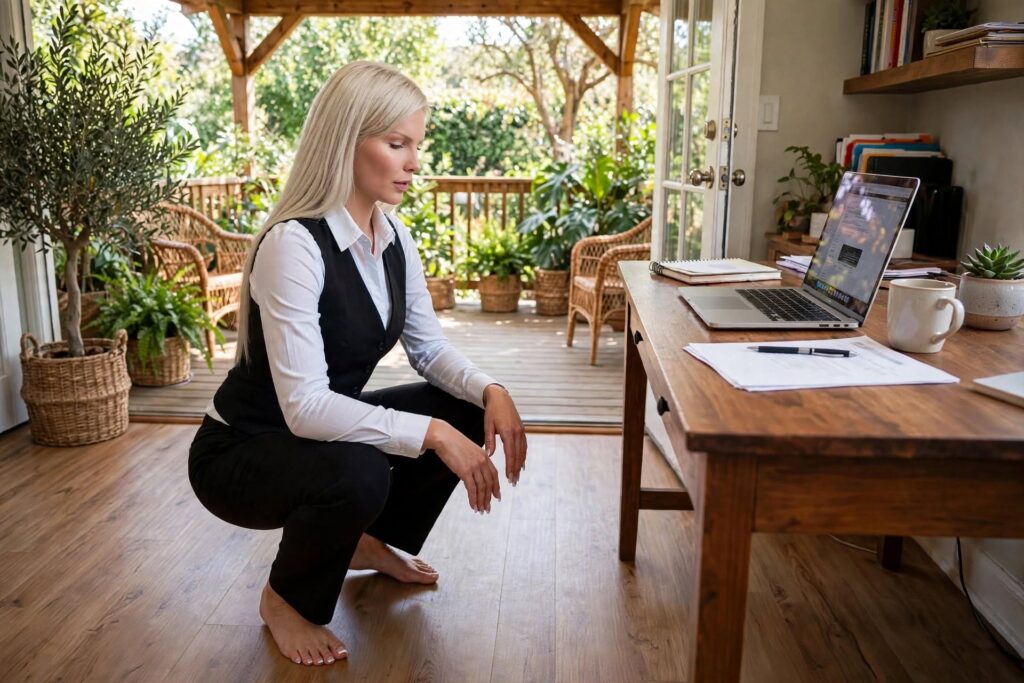
Try bringing this habit back:
- Practise a comfortable squat while holding a sturdy support if needed.
- Sit on the floor occasionally, using a cushion if that helps.
- When sitting on the floor, change positions rather than holding one posture for a long time.
- Practise getting down to the floor and standing up again at a pace that feels manageable.
If squatting deeply is uncomfortable, work within your current range. You can gradually build mobility and strength rather than forcing a position your body isn’t ready for.
2) Walking as Part of Everyday Life
Walking has become something many people schedule specifically for exercise. We put on our shoes, set a target and head out for a walk. That’s a good habit, but it isn’t the only way walking can fit into a day.
In the past, walking was often built into ordinary tasks: travelling between places, visiting neighbours, collecting supplies or getting to work. How much people walked varied enormously depending on their occupation, location and circumstances, but movement was often less separate from daily life.
Today, a person might drive to work, sit for most of the day, drive home and then try to make up for the lack of movement with a workout. Exercise is valuable, but there are also opportunities to move throughout the hours in between.
Walking is accessible to many people and can be adapted to different fitness levels. It doesn’t have to be fast or far to be worthwhile.
Try bringing this habit back:
- Walk during a phone call when it is safe and practical.
- Take a short walk after lunch or dinner.
- Park a little farther away when the route is safe.
- Walk to a nearby destination instead of driving when it makes sense.
- Break a long sitting period with a few minutes of movement.
You don’t need to turn every errand into a fitness challenge. Start by noticing where walking could fit naturally into your day.
The bigger lesson is that movement doesn’t always need its own time slot. Sometimes the easiest way to become more active is to build walking back into the things you already do.
3) Using Our Hands: Carrying, Lifting and Practical Work
Our hands do an enormous amount of work, but much of it has changed. We type, tap screens, scroll and use tools designed to make physical tasks easier. These activities have their place, of course, but they don’t necessarily challenge our grip and upper-body strength in the same way as carrying, lifting and handling objects.
Everyday physical work once provided many people with regular opportunities to use their hands and bodies. Carrying water, moving supplies, gardening, repairing things and preparing materials could all involve gripping, lifting and controlling loads.
That doesn’t mean hard manual labour is something everyone should seek out. Repetitive or heavy work can also cause pain and injury. The useful lesson is to maintain a variety of manageable physical tasks rather than relying entirely on machines or avoiding physical effort altogether.
Try bringing this habit back:
- Carry your own shopping bags when the loads are comfortable and manageable.
- Do some gardening, cleaning or simple DIY work.
- Practise appropriate strength exercises that involve gripping and carrying.
- Use a backpack or divide loads when carrying everything in your hands would be awkward.
- Lift objects close to your body and avoid twisting under a heavy load.
Start with light loads and increase them gradually. If a task causes pain, change how you do it or choose another activity.
4) Bending, Reaching, Pushing and Pulling
Daily life requires more than walking in a straight line. We bend to pick things up, reach to put objects away, push doors open, pull drawers out and turn to look behind us.
These movements can become less varied when our days revolve around desks, cars and familiar workstations. We may spend hours in roughly the same positions, then expect a short workout to cover every physical quality we need.
The answer isn’t to worry about maintaining one perfect posture. Bodies are designed to move, and there isn’t one position that needs to be held all day. A more useful goal is to change positions regularly and keep practising a comfortable range of movements.
Try bringing this habit back:
- Stand up to reach for objects instead of doing everything from a seated position.
- Put away laundry, tidy shelves or do light household tasks that involve different directions of movement.
- Practise controlled hip hinges to learn how to bend while keeping a load close to your body.
- Include pushing and pulling movements in your strength routine.
- Take regular breaks to stand, walk and change position during long periods at a desk.
There is no need to turn ordinary chores into a workout. Just avoid making your daily movement more restricted than it needs to be.
5) Climbing, Balancing, Playing and Moving in Different Ways
Children rarely think about movement in terms of training plans. They run, crawl, climb, balance, jump, roll and change direction because they are playing. Adults often lose some of that variety as responsibilities grow and leisure becomes more sedentary.
Of course, not every adult needs to climb trees or jump over obstacles. The point is that movement can involve coordination, balance and different directions—not just walking forward or lifting weights in a predictable pattern.
Balance and coordination are useful physical skills. They also benefit from practice. If your usual routine consists of sitting, walking on level ground and perhaps using a few gym machines, you may have fewer opportunities to challenge those skills.
Try bringing this habit back:
- Practise standing on one leg near a wall or sturdy support.
- Step over low, stable obstacles when the surroundings are safe.
- Dance to a few songs or play an active game with friends or family.
- Try beginner-friendly crawling or floor-to-standing movements.
- Explore a new activity, such as hiking, martial arts, recreational swimming or dancing.
Choose activities that match your ability and surroundings. You don’t need to perform impressive movements; even simple balance and coordination exercises can add variety.
6) Spending Time Outdoors and Taking Breaks from Screens
Modern life often keeps us indoors for much of the day. We work on screens, relax with screens and sometimes spend our free time moving between one device and another.
Being outdoors offers a different experience. A walk through a park, time in the garden or a trip to a local trail can combine movement with changing scenery and natural daylight. You may walk on uneven ground, look into the distance, notice your surroundings and move at a different pace from your usual indoor routine.
Outdoor activity isn’t automatically better for everyone, and access to safe green spaces varies. Still, where practical, spending some time outside can be a useful way to add movement and variety to the day.
Natural daylight also plays an important role in regulating our circadian rhythm, the body’s internal 24-hour clock that influences our sleep-wake cycle and helps regulate various bodily functions. Modern indoor routines can mean we get less daylight during the day and more artificial light in the evening. Making time to go outdoors during daylight hours is one simple way to help keep our daily rhythms in sync with the natural light-dark cycle. You can read more in the National Institute of General Medical Sciences’ explanation of circadian rhythms.
Screen breaks also matter for comfort. The American Academy of Ophthalmology recommends the 20-20-20 rule as one way to reduce digital eye strain: every 20 minutes, look at something at least 20 feet away for 20 seconds. It is a simple reminder to pause near work, not a guarantee against every eye problem.
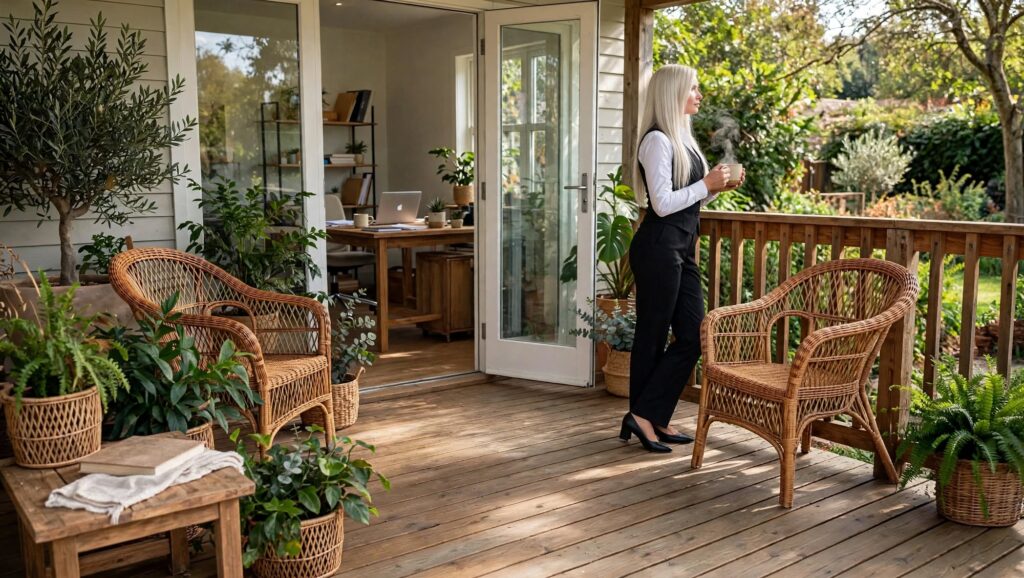
Try bringing this habit back:
- Take a short outdoor walk during a break.
- Spend a little time gardening or doing another outdoor task.
- Look away from your screen regularly and focus on something in the distance.
- Take a few steps or change position between work sessions.
- When possible, combine your screen break with a movement break.
The aim isn’t to reject technology. It’s to make sure technology doesn’t quietly occupy every spare moment that could be spent moving, looking around or enjoying the outdoors.
How Often Should You Get Up from Your Desk?
If you spend most of your working day sitting, a simple starting point is to get up and move around every 30 minutes. You don’t need to take a long break—even one or two minutes of movement can help break up prolonged sitting.
You could walk to get a glass of water, stretch gently, or stand up and sit down a few times. The idea is to interrupt long periods of sitting rather than remain in the same position for hours.
Try this simple routine:
- Every 30 minutes: Get up from your desk.
- For 1–3 minutes: Walk around, stretch or do a few comfortable movements.
- Then return to work: Repeat throughout the day.
The 30-minute mark is a practical target, not a strict medical rule. The important thing is to move regularly and avoid sitting for excessively long, uninterrupted periods.
You don’t have to abandon your work every time a timer goes off. Start by building regular movement breaks into your day and make them a habit.
How to Bring Natural Movement Habits Back into Your Daily Life
Reading about movement is easy. Changing your routine is the part that takes practice, so don’t try to overhaul your entire day at once.
Start with one or two changes that feel realistic. Once they become familiar, add another.
For example, a simple day might look like this:
- Morning: Walk for a few minutes or move through some comfortable stretches before settling down to work.
- During work: Stand up, change position and take short movement breaks.
- Around the house: Carry manageable items, tidy up, garden or complete practical tasks.
- Later in the day: Go for a walk, practise a few balance exercises or spend time playing an active game.
- While relaxing: Change positions occasionally rather than staying in the same posture for hours.
These ideas are not a substitute for all structured exercise. The WHO recommends that adults aim for 150–300 minutes of moderate-intensity aerobic activity per week, or an equivalent combination of moderate and vigorous activity, alongside muscle-strengthening activity. The appropriate starting point depends on your current activity level, health and abilities.
If you’re currently inactive, begin with small amounts and build gradually. Consistency matters more than trying to do everything perfectly from day one.
The Takeaway: You Don’t Need to Train All Day—Just Move More Often
Modern life has made many things easier, and there is no reason to give up those conveniences simply to imitate the past. But we can be more deliberate about the movements that have disappeared from our routines.
Walk when it makes sense. Get down to the floor occasionally. Carry manageable loads, reach, bend, balance and spend time outdoors when you can. Break up long periods of sitting, and choose activities that make movement enjoyable rather than another chore.
The goal isn’t to move like an ancestor or follow a perfect routine. It’s to keep your body involved in everyday life instead of asking it to remain still for most of the day and perform all its work in one short workout.
Start with one small change today. Make it a habit, then build from there.
